
Golden Teacher Mushrooms: The Complete Strain Guide for Researchers
What Are Golden Teacher Mushrooms?
Golden Teacher mushrooms are a variety of Psilocybe cubensis, one of the most widely distributed and studied species in the Psilocybe genus. You can spot them by their golden to caramel-brown caps, often flecked with yellow speckles, and their medium-to-large size. Among the hundreds of cubensis varieties catalogued by mycologists, Golden Teacher stands out as the single most popular strain in the world.
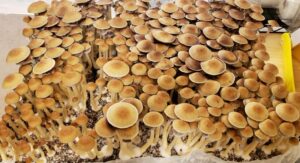
So what earned this particular variety its name? Two things. The cap color is unmistakably golden, especially when catching light. And the “teacher” part connects to a tradition stretching back thousands of years, where cultures from the Mazatec to the Nahua regarded psilocybin mushrooms as organisms that impart knowledge. The Mazatec called them nti si tho (“the ones who leap forth”) and the Nahua knew them as teonanacatl (“flesh of the gods”). Golden Teacher fits right into that lineage.
For researchers working with mushroom spore syringes and spore prints, Golden Teacher is often the first strain they study. The reasons are practical: GT produces spores in abundance, the morphological features are distinct and well-documented, and there is more published reference material on this variety than almost any other cubensis strain.
Scientific classification:
| Rank | Classification |
|---|---|
| Kingdom | Fungi |
| Division | Basidiomycota |
| Class | Agaricomycetes |
| Order | Agaricales |
| Family | Hymenogastraceae |
| Genus | Psilocybe |
| Species | P. cubensis |
| Variety | Golden Teacher |
Origin and History
The exact origin of the Golden Teacher variety is one of mycology’s open questions. The first documented specimens appeared in the 1980s, and most sources point to Florida as the likely location where they were first collected. Beyond that, the trail goes cold. No one has been able to pin down exactly who isolated the original culture or how it got its name.
What we do know is that Golden Teacher spread quickly through the mycology community during the late 1980s and 1990s. Its forgiving nature, consistent characteristics, and prolific spore production made it a favorite among researchers and hobbyist microscopists alike. By the early 2000s, GT had become the default “starter strain” recommended in mycology forums and educational resources.
The cultural history of psilocybin mushrooms goes back much further, of course. Cave paintings at Tassili n’Ajjer in Algeria, dating to roughly 7,000-9,000 BCE, depict figures adorned with mushroom imagery during what appear to be ritual scenes. While those ancient mushrooms were not Golden Teacher specifically, GT is a modern representative of the same Psilocybe genus that humans have been fascinated by for millennia. For more on psilocybin’s legal status, see our guide on whether mushroom spores are legal.
Physical Characteristics and Identification
Golden Teacher mushrooms have a distinctive look that sets them apart from other cubensis varieties. Here is what to look for:
Cap: The cap ranges from 2 to 8 cm in diameter at maturity. The color shifts from a lighter golden-yellow in younger specimens to a deeper caramel-brown as they age. Most caps show scattered yellow or gold speckles across the surface. The shape starts convex, then flattens out and sometimes develops a slight raised center (called an umbo) as the mushroom matures. The cap edges can appear slightly wavy in older specimens.
Stem (stipe): Medium thickness, typically 5-12 cm tall. The color is whitish to pale yellow, and the surface has a somewhat fibrous texture. Like most cubensis varieties, the stem will bruise blue when damaged. This bluing reaction is caused by the oxidation of psilocin and is a well-known identification marker across the Psilocybe genus.
Gills: Closely spaced, attached to the stem (adnate to adnexed). They start out pale gray in young mushrooms and darken to a purple-brown or nearly black color as the spores mature. A partial veil connects the cap edge to the stem in younger specimens, eventually tearing to leave a thin ring (annulus) on the upper stem.
Spore print: Dark purple-brown to nearly black. This is consistent across most cubensis varieties, but it remains an important identification characteristic.
Overall impression: Compared to other cubensis strains, Golden Teacher has a “classic mushroom” appearance. The proportions are balanced and elegant. Where Penis Envy mushrooms are stocky with small, often unopened caps, Golden Teacher looks more like what most people picture when they think of a typical mushroom.
Quick Identification Reference
| Feature | Golden Teacher | Typical Cubensis (generic) |
|---|---|---|
| Cap color | Golden-brown with yellow speckles | Varies, usually brown |
| Cap diameter | 2-8 cm | 2-8 cm |
| Stem height | 5-12 cm | 4-15 cm |
| Stem thickness | Medium | Varies |
| Spore print | Dark purple-brown | Dark purple-brown |
| Distinguishing feature | Gold speckles on cap, balanced proportions | Varies by variety |
Golden Teacher Spores Under the Microscope
For microscopists, Golden Teacher spores are among the most rewarding to study. They have clear, well-defined features that are easy to observe even at moderate magnification.
Spore dimensions: Golden Teacher spores fall within the typical P. cubensis range of approximately 11-17 x 7-12 micrometers. They tend to cluster toward the middle of this range, making them slightly more uniform in size than some other varieties.
Shape: Subellipsoid (roughly oval, slightly narrower at one end). Under oil immersion at 1000x, you can see the smooth surface and a visible germ pore at one end. The wall thickness is moderate, and the spores appear semi-transparent with a golden to purple-brown tint depending on how many spores are layered on the slide.
Why GT spores are ideal for beginners: Three reasons stand out. First, Golden Teacher drops spores heavily. When a mature cap opens, it releases large quantities of spores, which means spore prints and spore syringes tend to have dense, easy-to-work-with concentrations. Second, the spore morphology is consistent specimen to specimen, so what you see under the microscope matches the reference images in mycology literature. Third, because GT is so popular, there is a huge body of photomicrographs and published observations to compare your own slides against.
Tips for Preparing Golden Teacher Spore Slides
- Start with a clean glass slide and coverslip
- Place a small drop of sterile water on the slide
- Using a sterile needle, transfer a tiny amount of spore material from your spore syringe to the water drop
- Gently place the coverslip over the sample (avoid air bubbles)
- Begin observation at 100x, then move to 400x for detail work
- For maximum detail, use oil immersion at 1000x
Why Golden Teacher Is the Best Strain for Beginner Researchers
If you ask experienced microscopists which strain they recommend for someone just starting out, the answer is almost always Golden Teacher. Here is why:
Prolific spore production. GT is one of the heaviest spore producers among cubensis varieties. This means you get dense, viable spore samples whether you are working with a spore syringe, a spore print, or a liquid culture. More spores on your slide means clearer observations.
Well-documented morphology. Because GT is the most studied cubensis variety, there are thousands of published micrographs and field observations to reference. When you are learning to identify spore features under a microscope, having reliable reference material makes a huge difference.
Consistent characteristics. Some cubensis varieties show a lot of variation from specimen to specimen. GT is relatively stable, so the spores you observe today will look much like the ones you study next month. That consistency helps beginners build pattern recognition.
Available in every format. At Spores Worldwide, Golden Teacher is available as a spore syringe, a spore print, and a liquid culture. This means you can experiment with different preparation methods and compare results across formats.
Golden Teacher vs. Other Popular Strains
How does Golden Teacher stack up against the other popular cubensis varieties? Here is a side-by-side comparison of the four most commonly studied strains.
[Image needed: Visual comparison infographic showing Golden Teacher, Penis Envy, B+, and Blue Meanie side by side with their key features]
| Feature | Golden Teacher | Penis Envy | B+ | Blue Meanie |
|---|---|---|---|---|
| Cap color | Golden-brown, speckled | Pale, bulbous | Light caramel-brown | Pale brown to tan |
| Cap size | Medium-large (2-8 cm) | Small, often closed | Large (up to 10 cm) | Medium (2-6 cm) |
| Stem | Medium thickness, whitish | Thick, dense, meaty | Tall, thick | Medium, whitish |
| Spore drop | Heavy (very prolific) | Light (cap often stays closed) | Heavy | Moderate |
| Beginner-friendly | Yes (most recommended) | No (harder to study) | Yes | Moderate |
| Distinguishing trait | Gold-speckled cap | Penis-shaped morphology | Large size, mild character | Strong bluing reaction |
Golden Teacher vs. Penis Envy: These two are the most frequently compared cubensis strains, and they could not be more different. GT has the classic mushroom shape with a wide, open cap that drops spores freely. Penis Envy has thick, stubby stems with small caps that often do not fully open, making spore collection much harder. For microscopy work, GT is the better starting point. PE is fascinating once you have more experience, and its unique morphology makes for interesting study, but the limited spore production adds difficulty.
Golden Teacher vs. B+: These two are both considered great beginner strains. B+ tends to produce larger individual specimens, and some researchers report slightly more variation in cap morphology. GT edges ahead for first-time microscopists because of its more extensive reference literature and slightly more uniform spore characteristics.
Golden Teacher vs. Blue Meanie: Blue Meanie (the P. cubensis variety, not to be confused with Panaeolus cyanescens) is known for its strong bluing reaction when handled. It is a solid strain for intermediate microscopists. GT remains the better starting point for beginners due to heavier spore production and more widely available reference material.
Where to Get Golden Teacher Spores for Microscopy
When choosing a spore vendor, look for these things: preparation in a sterile environment (HEPA-filtered cleanroom is the standard), clear labeling, proper storage during shipping, and a vendor who positions their products for microscopy and research use.
At Spores Worldwide, Golden Teacher spores are available in three formats:
- Golden Teacher Spore Syringe — 10cc of GT spores suspended in sterile water. The most popular format for microscopy. Ready to use right out of the package.
- Golden Teacher Spore Print — A spore deposit taken directly from a mature GT cap onto foil. Great for long-term storage and creating your own spore suspensions.
- Golden Teacher Liquid Culture — Live mycelium in a sterile nutrient solution. A different way to study GT biology under the microscope.
All of our spore products are prepared in a HEPA-filtered cleanroom and shipped from Canada to customers worldwide.
Frequently Asked Questions
What are Golden Teacher mushrooms?
Golden Teacher mushrooms are a variety of Psilocybe cubensis recognized by their golden-brown caps with yellow speckles. First documented in the 1980s (likely in Florida), they have become the most popular and widely studied cubensis strain in the world. Microscopists value them for their prolific spore production and well-defined morphological features.
Why are they called Golden Teacher?
The name comes from two things: the mushroom’s golden-caramel cap color, and the long cultural tradition of viewing psilocybin-containing mushrooms as “teachers.” Ancient cultures, from the Mazatec people of Mexico to the Nahua, described these mushrooms as organisms that impart knowledge or prompt new perspectives.
Are Golden Teacher spores legal?
In most places, yes. Golden Teacher mushroom spores are legal to purchase for microscopy and research purposes because they contain no psilocybin or psilocin. In the United States, spores are legal in 47 out of 50 states (California, Idaho, and Georgia have restrictions). In Canada, mushroom spores are fully legal to buy and possess for research.
What do Golden Teacher spores look like under a microscope?
GT spores are subellipsoid (oval-shaped), approximately 11-17 x 7-12 micrometers in size, with a smooth surface and visible germ pore. Under the microscope, they appear semi-transparent with a purple-brown tint. At higher magnification (400x-1000x), the wall structure and germ pore become clearly visible.
Is Golden Teacher a good strain for beginner microscopists?
Golden Teacher is widely considered the best cubensis strain for beginners. It produces spores in heavy quantities, has consistent and well-documented morphological features, and has more published reference material than any other cubensis variety. GT spores are available as spore syringes, spore prints, and liquid cultures.
Start Your Research with Golden Teacher Spores
Golden Teacher is the world’s most popular cubensis strain for a reason. Whether you are picking up your first spore syringe or adding another variety to your microscopy collection, GT is a reliable starting point with well-documented characteristics and easy-to-study spores.
Browse Golden Teacher products at Spores Worldwide:
- Golden Teacher Spore Syringe — 10cc, ready for microscopy
- Golden Teacher Spore Print — Collected from mature specimens
- Golden Teacher Liquid Culture — Live mycelium in nutrient solution
Explore more strains:
- All Spore Syringes (27 varieties)
- All Spore Prints
- All Liquid Cultures
Related reading: