
Penis Envy Mushrooms: The Complete Guide to the Most Sought-After Cubensis Strain
What Are Penis Envy Mushrooms?
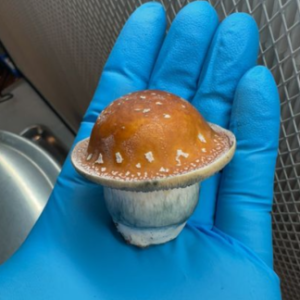
Penis Envy mushrooms are a variety of Psilocybe cubensis known for a morphology that sets them apart from every other cubensis strain. Where most cubensis varieties grow with a wide, open cap on a relatively slender stem, Penis Envy does the opposite: thick, dense stems topped by small, bulbous caps that often refuse to fully open. The overall shape is unmistakable, and it is how the strain got its name (more on that story below).
Among the hundreds of documented P. cubensis varieties, PE occupies a unique position. It is one of the most talked-about strains in mycology communities, one of the most frequently requested by researchers, and the parent strain behind at least six well-known variants. If you spend any time in mushroom forums or on mycology subreddits, you have probably seen the saying attributed to veteran Shroomery user RogerRabbit: “Cubes are cubes, with the exception of PE.”
For microscopists working with spore syringes and other spore products, Penis Envy presents an interesting challenge. Unlike prolific spore producers such as Golden Teacher, PE drops spores sparingly because the cap tends to stay partially closed. This makes PE spores somewhat rarer to collect and study, which only adds to the strain’s appeal for experienced researchers.
Scientific classification:
| Rank | Classification |
|---|---|
| Kingdom | Fungi |
| Division | Basidiomycota |
| Class | Agaricomycetes |
| Order | Agaricales |
| Family | Hymenogastraceae |
| Genus | Psilocybe |
| Species | P. cubensis |
| Variety | Penis Envy |
Physical Characteristics and Identification
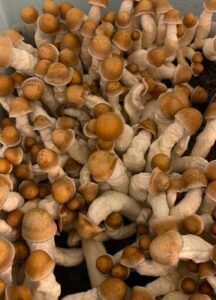
Penis Envy mushrooms are easy to identify once you know what to look for. The morphology is distinct enough that even people new to mycology can usually pick PE out of a lineup.
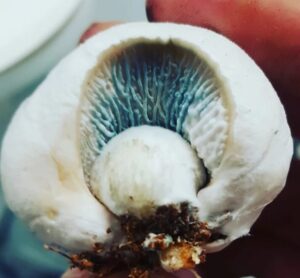
Cap: Small relative to the stem, typically 2-5 cm in diameter. The shape is rounded and bulbous, and the cap frequently does not open flat the way most cubensis varieties do. Color ranges from a light tan to pale caramel. In many specimens, the cap remains partially attached to the stem, forming a closed or semi-closed structure that gives PE its characteristic silhouette.
Stem (stipe): This is where PE really stands out. The stems are noticeably thicker and denser than standard cubensis. They have a pale, whitish color and a solid, meaty texture. When bruised or damaged, the stems show a strong blue reaction (oxidation of psilocin), which is pronounced in PE compared to most other cubensis varieties.
Gills: When visible (the cap has to open enough to expose them), the gills are closely spaced and darken from pale gray to dark purple-brown as spores mature.
Spore print: Dark purple-brown, consistent with other cubensis varieties. Collecting a full spore print from PE is harder than from other strains because the cap often does not open wide enough for a heavy spore deposit.
How PE Compares to Standard Cubensis
| Feature | Penis Envy | Standard Cubensis |
|---|---|---|
| Cap shape | Small, rounded, often stays closed | Wide, flattens at maturity |
| Cap size | 2-5 cm | 2-8 cm |
| Stem | Thick, dense, meaty | Thinner, more flexible |
| Stem height | 5-10 cm | 4-15 cm |
| Bluing reaction | Strong | Moderate |
| Spore drop | Light (cap often closed) | Heavy |
| Spore print difficulty | Harder to collect | Easy |
The Origin of Penis Envy Mushrooms
The origin story of Penis Envy mushrooms is one of mycology’s most debated topics. Multiple accounts exist, and not all of them agree. Here is what we know, and what remains uncertain.
The most widely circulated theory starts with Terrence and Dennis McKenna, the brothers whose Amazonian expeditions in the early 1970s produced some of the most significant Psilocybe cubensis specimens ever collected. Journalist and pharmacologist Hamilton Morris, who has spent years investigating the history of psychoactive substances, proposed that the original Penis Envy specimen came from one of these Amazonian collections. Morris described the original mushroom as “taller and thicker than anything found in American soils” and “a monstrous Amazonian mushroom growing on the dung of local Zebu cattle.”
According to Morris’s theory, spore prints from this Amazonian collection eventually made their way to Steven Pollock, a pioneering Psilocybe cubensis mycologist. Pollock is believed to have isolated the unique genetics from the original sample, selecting for the traits that would become the Penis Envy morphology. Before his death, Pollock reportedly mailed a spore print labeled simply “Penis” to another mycologist and print vendor named Rich Gee.
John Allen (known as “Mushroom John” or mjshroomer on the Shroomery forums) later located Rich Gee selling spore swabs of Penis Envy, which helped bring the strain to wider attention. Around the same time, a Shroomery user claimed to possess a print from Terrence McKenna’s personal collection, though this may have stemmed from confusion about the chain of custody.
That is the commonly told version. But the person who was actually there tells a different story.
The Rich Gee Account: An Exclusive First-Hand Source
Spores Worldwide received a direct message from Rich Gee himself, offering his first-hand account of how the Penis Envy mushroom strain came to be. His version differs significantly from John Allen’s claims, and it comes from someone who was present when the key events happened.
In Rich Gee’s words:
The Penis Envy mushrooms began with Jewel Stevens [sic; likely Jule Stevens] who dropped by my house to show me some Amazon mushrooms he had acquired. They supposedly came from Terence McKenna in a roundabout way. There was no bloody letter with spores sent to me by anyone. The mushrooms I saw were dried and looked normal. I cultured the spores and the mushrooms were grown in a hexagon plexiglass fish tank by Jule Stevens. In the tank there were 3 distinct strains, 2 normal and one different enough to attract my attention. This strain did not look like a penis. The strain was cultivated and the mushrooms that grew were long-stemmed with big heads. I picked the biggest one which just happened to be the one that blued the most. The next generations started to look like penises. Again the biggest and bluest one was cloned. For several more generations the biggest and most bluing mushroom was cloned culminating in large penis looking mushrooms. There was never any contact with McKenna and we never met to my knowledge.
So according to Rich Gee, the Penis Envy morphology was not something that appeared naturally in the Amazon. It was the result of deliberate selective isolation over multiple generations, choosing the biggest specimens with the strongest bluing reaction each time. What started as a normal-looking cubensis gradually developed the thick stems and rounded caps that define the strain today.
And the name? That has its own story too:
One day I collected a bag full of mushrooms from a friend who was growing the Penis Envy so I could photograph them. At the time Jewel Stevens was dating an exotic dancer and when I stopped to visit him there were 6 dancers visiting his girlfriend. They wanted to know what I had in the bag. I said, “You don’t want to know.” They insisted so I pulled a gallon zip lock out of the bag and showed them the mushrooms. I said, “Anyone have Penis Envy!” The dancers said in unison, “They look like donkey dongs!!!” That’s where the name came from.
Rich Gee also addressed the accounts told by John Allen directly: “Mushroom John has told many stories about the Penis Envy but none of it is correct and mostly his imagination.”
The fact remains that PE was developed through careful selective cloning from an Amazonian cubensis sample, likely originating from a McKenna collection. The selective process that Rich Gee describes, picking the largest and most strongly bluing specimen from each generation, is what produced the morphology that makes Penis Envy so distinct today.
Penis Envy Variants
Over the decades since Rich Gee’s original isolation work, mycologists have crossed and further isolated Penis Envy genetics to create a family of PE-derived strains. Each variant has its own distinct characteristics worth studying under the microscope.
Albino Penis Envy (APE)
A cross between Penis Envy and an albino cubensis strain. APE is recognized by its ghostly white coloring across both the cap and stem. The morphology is similar to standard PE (thick stems, small caps) but with the added visual interest of the albino phenotype. APE produces even fewer spores than regular PE, making quality spore samples especially prized by collectors.
Penis Envy #6 (PE6)
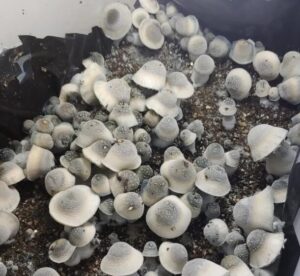
A cross between Penis Envy and a Texas cubensis strain. PE6 shows a blend of both parent characteristics. The stems are thick like PE but not quite as dense, and the caps tend to open more readily. This makes PE6 easier to collect spore prints from, giving it a practical advantage for microscopists who want PE genetics without the difficulty of collecting spores from a fully closed cap.
Penis Envy Uncut
Named because the cap appears to stay fused to the stem, looking “uncut.” This variant takes the closed-cap characteristic of standard PE and pushes it further. Penis Envy Uncut Revert is the stabilized version most commonly available as spore samples.
Albino Penis Envy Revert (APER)
A stabilized mutation that emerged from Albino Penis Envy cultures. APER reverts to a partially pigmented phenotype (not fully albino) while retaining the thick PE morphology. For microscopists, APER is interesting because the spores show slightly different pigmentation compared to standard PE or full APE.
Choda (PE Mutant)
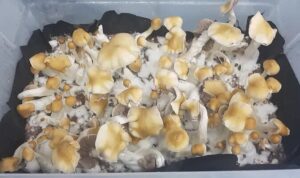
A PE mutant with a stockier, squatter profile than standard PE. Choda has proportionally wider stems relative to its height, giving it a compact, chunky appearance. The genetic backstory is less documented than other PE variants, but the morphology is distinct enough to make it a worthwhile subject for microscopy study.
Golden Penis Envy (GT x PE)
A hybrid of Golden Teacher and Penis Envy. Golden Penis Envy combines the golden cap coloring of GT with some of the dense-stem characteristics of PE. The result is a strain that looks different from both parents. For researchers interested in how cubensis genetics express themselves in crosses, GPE is a fascinating case study.
Penis Envy Pumpkin (Spore Swab)
A rarer PE variant available from Spores Worldwide as a spore swab. Spore swabs are collected by wiping a sterile cotton swab along the gills and are a different format than syringes or prints.
Penis Envy Spores Under the Microscope
Studying PE spores under a microscope is a different experience than working with a high-volume producer like Golden Teacher. Because Penis Envy caps often do not open fully, the spore yield per specimen is lower. But the spores themselves are well worth the effort.
Spore dimensions: PE spores fall in the typical P. cubensis range of approximately 11-17 x 7-12 micrometers. Some microscopists report that PE spores tend to cluster toward the larger end of this range, though this can vary specimen to specimen.
Shape and appearance: Subellipsoid, with a smooth surface and a visible germ pore at one end. Under the microscope, PE spores appear semi-transparent with a purple-brown to dark brown tint. The spore walls are moderately thick.
What makes PE spores interesting to study: The lower spore density per sample means each slide preparation is a bit different. Because PE drops fewer spores, you tend to get cleaner, less crowded fields of view at lower magnifications, which can actually make it easier to study individual spore characteristics in detail. At 400x and above, the germ pore and wall structure become clearly visible.
Working with PE spore syringes: A Penis Envy spore syringe contains PE spores suspended in 10cc of sterile water. Shake the syringe gently before use to distribute the spores evenly. Because the spore concentration may be lower than a Golden Teacher syringe, consider using a slightly larger drop on your slide.
Where to Buy Penis Envy Spores
At Spores Worldwide, we carry the full family of Penis Envy genetics. All products are prepared in our HEPA-filtered cleanroom and shipped from Canada to customers worldwide.
PE spore syringes (10cc, ready for microscopy):
– Penis Envy Spore Syringe (the original)
– PE6 Spore Syringe (Texas x PE cross)
– Choda Spore Syringe (PE mutant)
– Golden Penis Envy Spore Syringe (GT x PE)
– Albino Penis Envy Revert Spore Syringe
– Penis Envy Uncut Revert Spore Syringe
PE spore swabs:
– Penis Envy Pumpkin Spore Swab
PE liquid cultures:
– Penis Envy Liquid Culture (live mycelium in nutrient solution)
For information on the legal status of mushroom spores in your area, read are mushroom spores legal?
Frequently Asked Questions
Where did Penis Envy mushrooms originate?
According to mycologist Rich Gee (speaking directly to Spores Worldwide), the original Penis Envy genetics trace back to an Amazonian Psilocybe cubensis sample that came to him through a colleague named Jule Stevens. The Amazonian spores themselves are believed to have originated from a collection associated with Terrence McKenna. Rich Gee developed the Penis Envy morphology through multiple generations of selective cloning, choosing the largest and most strongly bluing specimens each time.
What makes Penis Envy different from other cubensis strains?
The most obvious difference is the morphology: thick, dense stems with small, rounded caps that often do not fully open. Internally, PE shows a stronger bluing reaction (oxidation of psilocin) than most cubensis varieties. Under the microscope, PE spores fall within the standard cubensis size range but tend toward the larger end, and they are harder to collect in quantity because the cap stays closed.
What are the different types of Penis Envy mushrooms?
The main PE variants are:
– Albino Penis Envy (APE) – white/albino phenotype
– Penis Envy #6 (PE6) – Texas x PE cross, opens more readily
– Penis Envy Uncut – cap stays fused to the stem
– Albino Penis Envy Revert (APER) – stabilized partially pigmented mutation
– Choda – stocky, squatter PE mutant
– Golden Penis Envy – Golden Teacher x PE hybrid
Are Penis Envy spores legal to purchase?
In most places, yes. Psilocybin mushroom spores are legal to buy for microscopy research in 47 of 50 US states (California, Idaho, and Georgia have restrictions) and throughout Canada. Spores contain no psilocybin or psilocin, which is why they are not classified as controlled substances in most jurisdictions.
How should I store my PE spore syringe?
Store your Penis Envy spore syringe in a cool, dark place between 2-8°C (35-46°F). A refrigerator works well. Avoid freezing, as ice crystals can damage the spores. Properly stored, a spore syringe remains viable for 6 to 12 months. For more detail, see our full spore storage guide.
Explore the Full Penis Envy Family
Whether you are studying the original PE genetics or branching out into the variants, the Penis Envy family offers some of the most interesting morphological diversity within Psilocybe cubensis. Few other strains have the backstory, the visual distinctiveness, or the range of sub-varieties that PE does.
Browse PE products at Spores Worldwide:
- Penis Envy Spore Syringe (the original)
- PE6 Spore Syringe
- Choda Spore Syringe
- Golden Penis Envy Spore Syringe
- Albino PE Revert Spore Syringe
- PE Uncut Revert Spore Syringe
- Penis Envy Liquid Culture
Explore more strains:
- All Spore Syringes (27 varieties)
- All Liquid Cultures
Related reading: