
By Sil, founder of Spores Worldwide · prepared in our Ottawa lab · Updated October 2026 · For microscopy and taxonomy research only.
A spore syringe holds mushroom spores suspended in sterile water. That makes it the quickest way to put spores on a microscope slide: a drop, a cover slip, and you’re ready to look. This guide walks through the whole process for Psilocybe cubensis spore syringes, from setting up your workspace to measuring spores at 1000×.
Our syringes are sold for microscopy and taxonomy research only. This guide covers microscopy. It doesn’t cover germinating or growing spores, and we don’t provide instructions for that. Check the law where you live first; our legal overview links to the statutes for the US and Canada.
What is in a spore syringe?
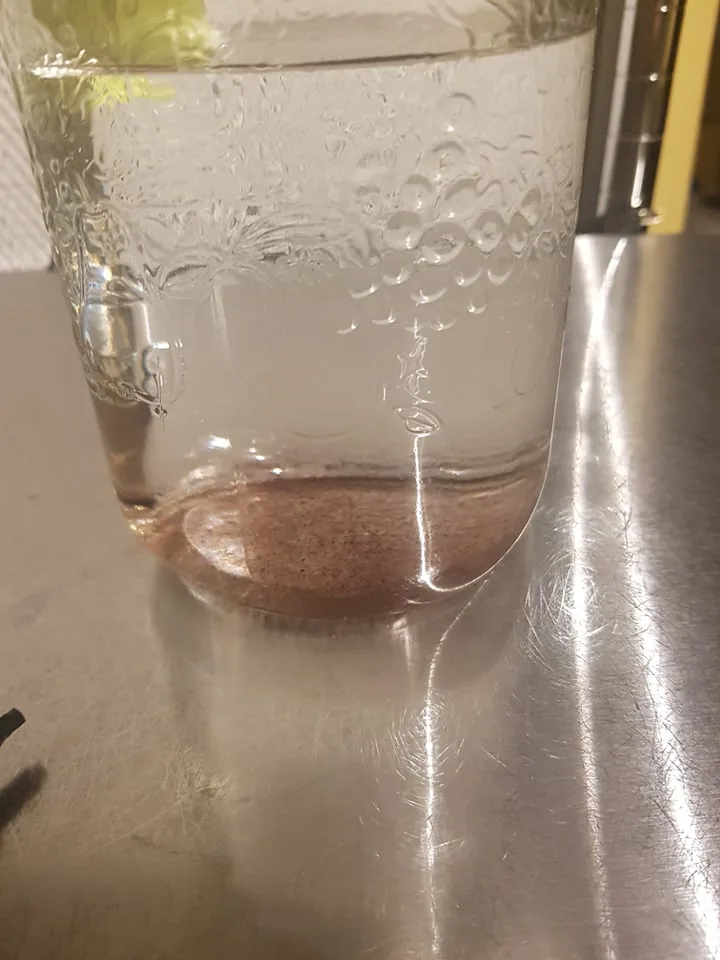
Each of our spore syringes is a 10cc syringe of sterile water with spores scraped from a spore print and suspended in it. Spores are tiny and denser than water, so between uses they settle. You’ll often see a faint cloud or a few dark specks near the bottom of the barrel. That’s normal, and it’s why the first step is always to resuspend them.

- A compound microscope with a 40× objective (400× total with a 10× eyepiece). A 100× oil-immersion objective (1000× total) shows the finest detail. Oil immersion increases the resolving power of the microscope.
- Glass slides and cover slips. Clean them with isopropyl alcohol and let them dry.
- Immersion oil, if you use a 100× objective.
- 70% isopropyl alcohol and lint-free wipes for your bench and hands (or gloves).
- An eyepiece reticle and a stage micrometer if you want to measure spores (see step 7).
- A notebook or camera to record what you see.
Step by step
1. Prepare a clean workspace
Wipe your bench and microscope stage with alcohol and let them dry. Work away from fans and open windows. You’re not trying to keep spores alive here, just to keep dust and fibres off your slide so they don’t confuse what you see.
2. Resuspend the spores
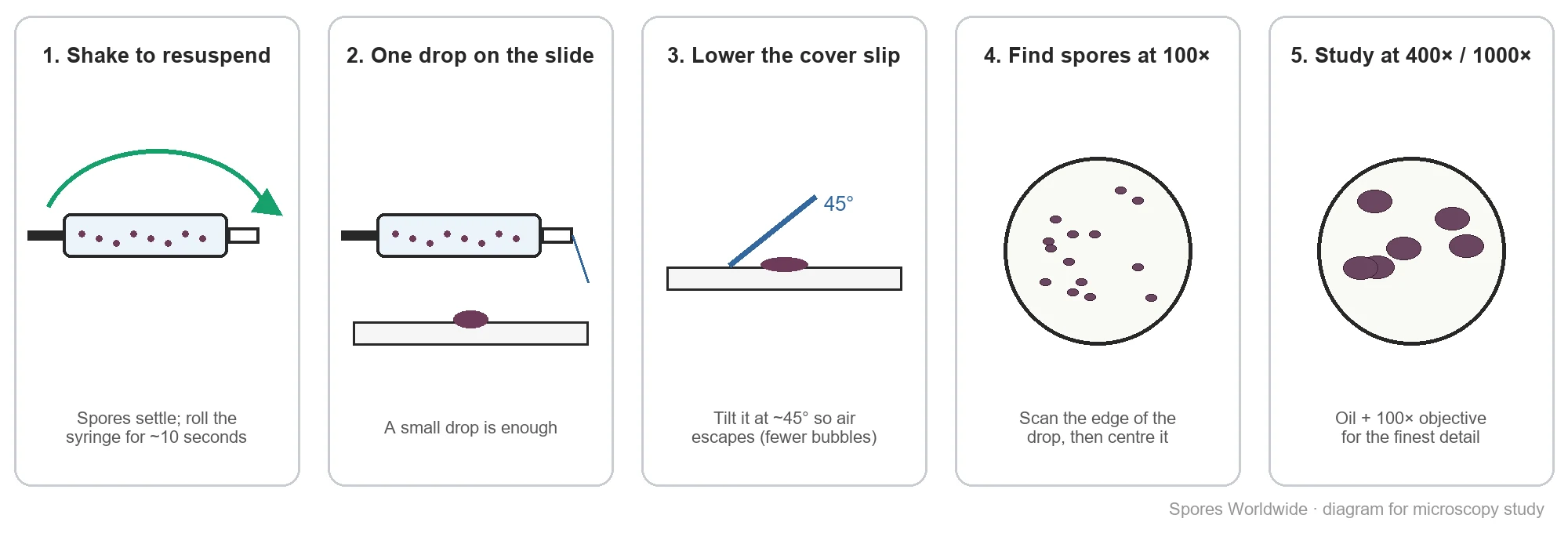
Roll the syringe between your palms or tip it end to end for about ten seconds. Settled spores collect at the bottom of any container of water.
3. Place one small drop on the slide
Remove the cap and push gently until a single small drop lands in the centre of the slide. A smaller drop gives a thinner, flatter layer under the cover slip, which is easier to focus. Recap the syringe straight away.
4. Lower the cover slip
Touch one edge of the cover slip to the slide beside the drop, then lower it at roughly 45°. This lets air escape instead of trapping bubbles. Bubbles look like perfect circles with thick dark rims; spores don’t.
5. Find the spores at low power
Start with the lowest objective (usually 10×, so 100× total). Spores are easiest to find near the edge of the drop, where they collect as the water spreads. Centre an area with plenty of spores, then switch to 40× (400×) and refocus with the fine-focus knob.
6. Study the detail at 1000×
For the finest detail, place a drop of immersion oil on the cover slip, rotate the 100× oil objective into place and focus carefully. Clean the oil off the objective with lens tissue when you’re done.
7. Measure and record
To measure spores you need an eyepiece reticle, calibrated against a stage micrometer (a slide with a ruled scale, typically 10 µm divisions). Calibrate each objective separately, because the value of each reticle division changes with magnification (ocular micrometer). Then:
- Measure the length and width of at least 20 spores, not just two or three. Spores from one sample vary.
- Record the range (for example “12–15 × 8–10 µm”), the strain, the date and the magnification.
- For comparison, published descriptions of P. cubensis give spores of 11.5–17.3 × 8–11.5 µm, sub-ellipsoid in shape (Psilocybe cubensis, Wikipedia).
8. Finish up
Wipe the syringe tip with alcohol, recap it, and return it to the refrigerator in its bag. Label every slide with the strain and date before you put it away.
What you should see
- Spores: smooth, oval to sub-ellipsoid bodies, all roughly the same size, often lying singly or in small groups. En masse, P. cubensis spores are dark purple-brown, the colour you see in a spore print.
- Air bubbles: perfect circles with heavy black outlines that change as you focus. Ignore them.
- Fibres and dust: long strands or irregular shapes much larger than spores. They usually come from the slide or the room, not the syringe.
Troubleshooting
| Problem | Likely cause | Fix |
|---|---|---|
| No spores visible | Spores settled before dispensing, or you’re looking in the wrong plane | Resuspend for longer; scan the edge of the drop at 100× |
| Too crowded to see single spores | Drop too large | Use a smaller drop, or add one drop of distilled water before the cover slip |
| Lots of bubbles | Cover slip dropped flat | Lower it at an angle from one side |
| Image fuzzy at 1000× | No oil, or oil on the wrong objective | Use immersion oil only with the 100× oil objective |
Where to go next
- Prefer a dry sample? See our spore prints and spore swabs.
- Building a reference set? Our spore syringe bundles let you compare several strains side by side.
- Strain background: Golden Teacher and Penis Envy.
Frequently asked questions
What magnification do I need to see mushroom spores?
You can find spores at 100× and see their shape clearly at 400×. A 100× oil-immersion objective (1000× total) shows the finest detail and is best for measuring.
Do I need a needle to make a slide?
No. For a microscope slide you only need to dispense a small drop, which you can do from the syringe tip. Recap the syringe straight away.
How many slides can I make from one syringe?
Each slide uses only a drop, so a 10cc syringe is enough for a large number of slides. Resuspend the spores before each use.
Why does my spore syringe look almost clear?
Spores are microscopic and settle to the bottom between uses. A syringe can look nearly clear with only a faint cloud or a few specks. Roll it for a few seconds and check a drop under the microscope.
Are spore syringes legal where I live?
That depends on where you live. Our legal overview links to the federal and state statutes in the US and to Canada’s Controlled Drugs and Substances Act. Always check your own local law before ordering.