
By Sil, founder of Spores Worldwide · prepared in our Ottawa lab · Updated October 2026 · For microscopy and taxonomy research only.
How you store spore samples decides how long they stay useful for microscopy. The good news is that it’s simple: keep them sealed, cool, dark and labelled. This guide covers spore syringes, spore prints and spore swabs, and what to do if something looks wrong.
All of our products are sold for microscopy and taxonomy research only.
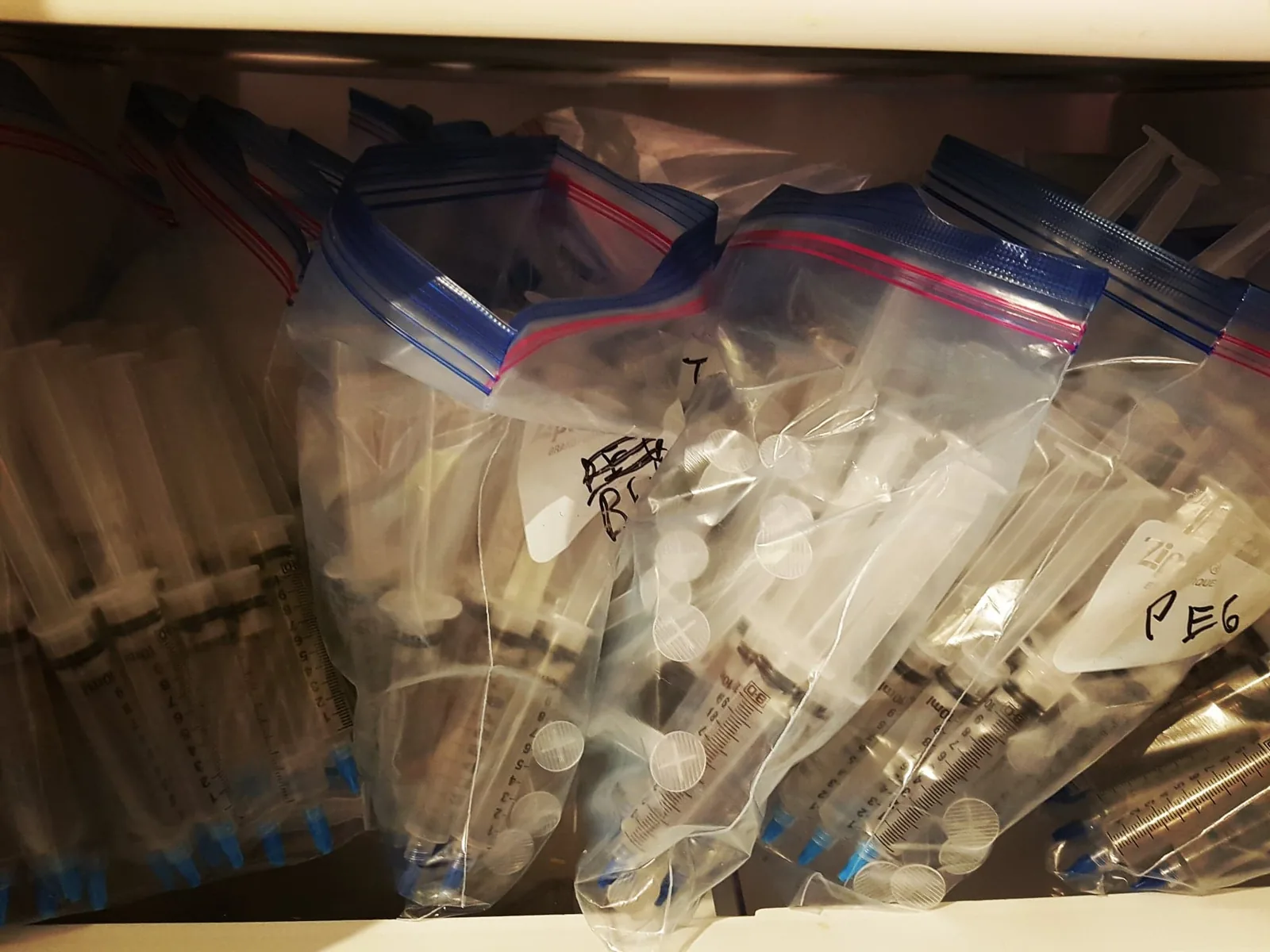
Spore syringes
- Refrigerate, don’t freeze. Keep syringes in the main part of the fridge, not the door, where the temperature swings every time it opens. Freezing is best avoided: ice crystals form in the water, which can damage the spores.
- Keep them dark. Leave each syringe in its bag, or in a box, away from light.
- Keep them sealed. Leave the cap on and the syringe in a sealed bag with most of the air pressed out.
- Label everything with the strain and the date you received it.
- Before each use, let the syringe come to room temperature and roll it to resuspend the spores (see our spore syringes page for what’s inside).
- Spore syringes can last upwards of 12 months if stored correctly, even many years in most cases.
Spore prints
- Keep them dry. Moisture is the main risk for a print. Store prints folded in their foil or paper inside a sealed bag.
- Cool and dark, away from direct sun and heat.
- Label each print with the strain and date.
- Handle by the edges and open the foil only when you’re about to take a sample.
- Keep your spore prints at room temperature or slightly below room temperature, in a sealed bag or container.
Spore swabs
Swabs come sealed in a sterile peel pouch. Keep the pouch sealed until you use it, flat, dry, and in a cool, dark place. Once opened, use it promptly.
Signs a syringe has a problem
Spores in sterile water should look like clear water with a faint cloud or a few dark specks. Contact us if you see any of these:
- The water has become cloudy or milky throughout.
- There are strands, clumps or fuzzy growth in the barrel.
- The syringe is damaged or leaking.
If anything arrives in that condition, email us within 14 days and we’ll replace it or give you store credit, as set out in our returns policy.
Quick reference
| Format | Where | Keep it | Avoid |
|---|---|---|---|
| Spore syringe | Fridge (not the door) | Capped, bagged, dark, labelled | Freezing, heat, light |
| Spore print | Cool, dark, dry place | Folded and sealed in a bag | Moisture, humidity |
| Spore swab | Cool, dark, dry place | Sealed in its pouch | Opening until needed |
Frequently asked questions
Do spore syringes need to be refrigerated?
We recommend it. A refrigerator keeps syringes cool and dark between uses. Store them in the main compartment rather than the door, and let them reach room temperature before use.
Can you freeze spore syringes or prints?
We don’t recommend it. Freezing forms ice crystals in the water of a syringe, which can damage the spores.
How should I store a spore print?
Keep it dry, folded in its foil or paper inside a sealed bag, in a cool, dark place, and labelled with the strain and date.
Why is my spore syringe clear?
Spores are microscopic and settle to the bottom, so a syringe often looks nearly clear. Roll it for a few seconds and check a drop under the microscope.
What if my syringe looks cloudy or has strands in it?
Contact us within 14 days of delivery and we’ll replace it or give you store credit, as set out in our returns policy.