
By Sil, founder of Spores Worldwide · prepared in our Ottawa lab · Updated October 2026 · For microscopy and taxonomy research only.
“Blue Meanie” is one of the most confusing names in mycology, because it belongs to two different mushrooms. One is a variety of Psilocybe cubensis. The other is a separate species in a different genus, Panaeolus cyanescens, which is also called “blue meanies”. This profile explains how to tell the two apart under the microscope, why both turn blue when damaged, and how to study Blue Meanie spores on a slide.
Spores Worldwide sells the Psilocybe cubensis variety only, as a spore syringe and a spore print, for microscopy and taxonomy research only. We don’t sell Panaeolus cyanescens.
The two Blue Meanies at a glance
| Feature | Psilocybe cubensis “Blue Meanie” | Panaeolus cyanescens |
|---|---|---|
| Genus and family | Psilocybe, Hymenogastraceae | Panaeolus |
| What “Blue Meanie” means | A named variety (strain) within the species | A common name for the whole species |
| Spore print colour | Purple to dark purple-brown | Black |
| Spore size | 11.5–17.3 × 8–11.5 µm | 12–15 × 7–11 µm |
| Spore shape | Sub-ellipsoid | Elliptical, smooth, opaque |
| Basidia | 4-spored (sometimes 2 or 3) | 4-spored |
| Where it grows | Cow dung, rich pasture soil | Dung, in tropical and subtropical regions |
Sources: spore and habitat data from Wikipedia’s Psilocybe cubensis and Panaeolus cyanescens articles. The cubensis figures are the published range for the species; we’ll add our own Blue Meanie measurements when our micrograph library is published.
Where the name comes from
The Blue Meanies are the villains of the Beatles’ 1968 animated film Yellow Submarine. The nickname is generally taken as a nod to them, and both mushrooms stain blue where they’re handled or bruised. With Panaeolus cyanescens, the name stuck to the whole species. With P. cubensis, it became the name of one variety, which is how two unrelated mushrooms ended up sharing it.
That’s why the genus matters whenever you see “Blue Meanie” on a label or in a forum post. A Psilocybe cubensis Blue Meanie print should look like any other cubensis print: purple-brown. A Panaeolus print is black.
Why Blue Meanies turn blue
For a long time, nobody knew exactly what the blue colour was. A 2020 study by Claudius Lenz and colleagues in Angewandte Chemie (open-access copy) worked it out using enzymes from Psilocybe cubensis:
- When the mushroom is damaged, an enzyme called PsiP removes the phosphate group from psilocybin, turning it into psilocin.
- A second enzyme, PsiL, oxidises the psilocin.
- The oxidised molecules link together into chains (mostly 3 to 13 units long), and those chains are blue.
The researchers also suggest that the phosphate group on psilocybin acts as a reversible protection, which is why intact tissue doesn’t turn blue.
Bluing on its own doesn’t identify a mushroom, though. Plenty of unrelated mushrooms stain blue for completely different chemical reasons: in many boletes the colour comes from variegatic acid. That’s another reason a spore print and the microscope are so useful: they give you features you can measure.
Telling the two apart under the microscope
Start with the spore print. This is the quickest and most reliable check. P. cubensis drops a purple to purple-brown print; Panaeolus cyanescens drops a black one. If you’re working from one of our Blue Meanie prints, the deposit should be dark purple-brown.
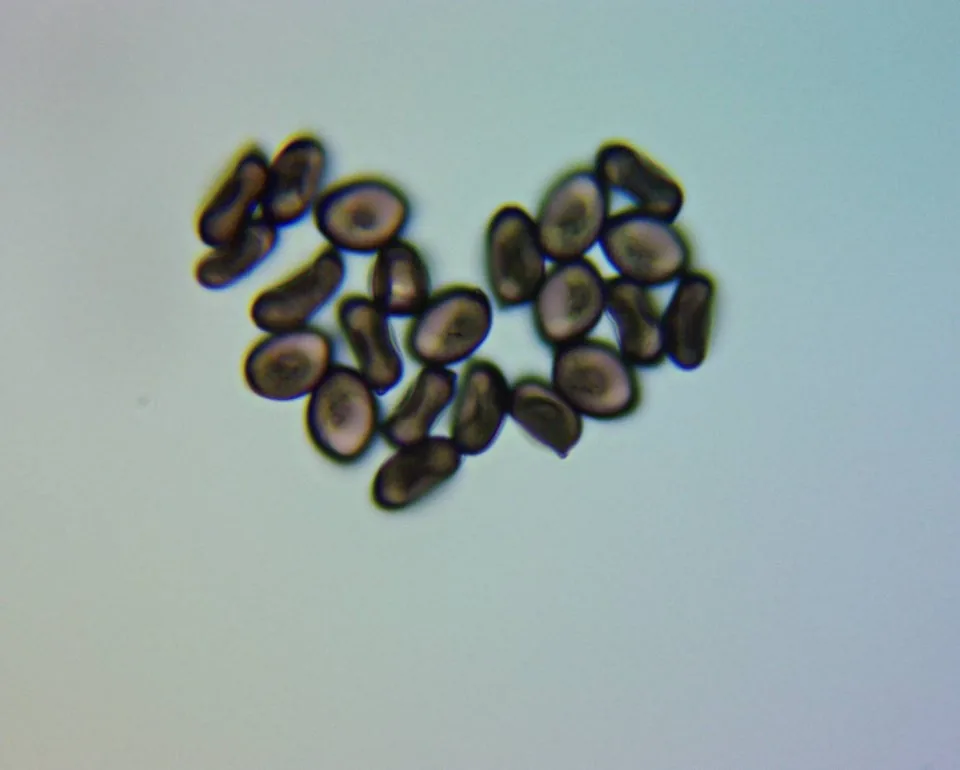
Then look at the spores. At 400× both appear as small, dark, elliptical cells, and their published sizes overlap (roughly 12–15 µm long for both), so size alone won’t separate them. Look at colour and translucency as well: Panaeolus cyanescens spores are described as opaque, and the black print colour carries through to the spores under the microscope. Compare what you see with reference images of each species, and record what you measured.
Studying Blue Meanie spores
- Prepare the slide: resuspend the syringe, place one small drop, and lower the cover slip at an angle. Step-by-step: How to use a spore syringe for microscopy.
- From a print: scrape a tiny amount of the deposit into a drop of sterile water on the slide. See How to make a spore print for how prints are made and handled.
- Magnification: find spores at 100×, check shape and colour at 400×, and measure at 1000× oil immersion with a calibrated eyepiece reticle. Measure 20 or more spores per sample and record length, width and shape.
- Compare: Blue Meanie makes a good comparison set with Golden Teacher and Penis Envy, since all three are varieties of the same species.
Store syringes capped, dark and cool in the main part of the fridge, and keep prints sealed and dry. Details: How to store spore syringes, prints and swabs.
Blue Meanie spores from Spores Worldwide
Each product is prepared by hand in our Ottawa lab under HEPA-filtered laminar flow. We ship to the USA, Canada and worldwide (except Egypt and Turkey).
- Blue Meanie Spore Syringe: 10cc of P. cubensis Blue Meanie spores in sterile water, ready for slide work.
- Blue Meanie Spore Print: a spore deposit on foil, good for print-colour study and long-term storage.
Browse every strain in Spore Syringes and Spore Prints.
Related reading
- Golden Teacher spores: strain profile
- Penis Envy spores: the PE family
- How to use a spore syringe for microscopy
- Are mushroom spores legal?
Frequently asked questions
Is Blue Meanie a Psilocybe or a Panaeolus?
Both, which is the source of the confusion. Blue Meanie is a named variety of Psilocybe cubensis, and it is also a common name for the separate species Panaeolus cyanescens. Spores Worldwide sells the Psilocybe cubensis variety only.
What colour is a Blue Meanie spore print?
A Psilocybe cubensis Blue Meanie print is purple to dark purple-brown, like other cubensis prints. Panaeolus cyanescens drops a black print.
Why do Blue Meanies bruise blue?
When the tissue is damaged, the enzyme PsiP converts psilocybin into psilocin, the enzyme PsiL oxidises it, and the oxidised molecules link into blue chains (Lenz et al., Angewandte Chemie, 2020).
Can you tell the two Blue Meanies apart under a microscope?
Partly. Their published spore sizes overlap, so start with the spore print colour (purple-brown for cubensis, black for Panaeolus), then compare spore colour and opacity at 400x to 1000x against reference images.
Are Blue Meanie spores legal?
It depends on where you live. Some jurisdictions restrict spores directly, and others restrict anything intended for producing mushrooms. Our guide, Are mushroom spores legal? (https://sporesworldwide.com/are-mushroom-spores-legal/), links to the laws for the US and Canada. Check your own local law before ordering.