
By Sil, founder of Spores Worldwide · prepared in our Ottawa lab · Updated October 2026 · For microscopy and taxonomy research only.
B+ (B plus) is a variety of Psilocybe cubensis and one of the oldest strain names still in circulation. It’s also the subject of one of mycology’s longest-running internet arguments: was it really a cross between two species? This profile covers where B+ came from, why the hybrid story doesn’t hold up, where it sits in the classification of fungi, and how to study B+ spores under the microscope.
Spores Worldwide sells B+ as a spore syringe and a spore print, for microscopy and taxonomy research only.
B+ at a glance
| Species | Psilocybe cubensis (family Hymenogastraceae) |
| Variety | B+ (B plus) |
| First circulated | Late 1990s; credited to a forum poster known as “Mr. G” |
| Hybrid claim | Said to be P. cubensis × P. azurescens; disputed, with no published genetic evidence we’re aware of |
| Spore print colour | Purple to dark purple-brown, like other cubensis |
| Spore size | 11.5–17.3 × 8–11.5 µm, the published range for P. cubensis (Wikipedia); our own measurements will follow when our micrograph library is published |
| Formats we sell | 10cc spore syringe and spore print on foil |
Where B+ came from
B+ dates from the early days of online mushroom forums. In April 1999, a poster on the Shroomery message board using the name “Mr. G” said he had created the B+ mushroom (Shroomery thread). Every B+ origin story goes back to his account, and nobody has been able to check it.
Nobody has recorded why it’s called B+ either. Unlike Golden Teacher or Penis Envy, the name doesn’t describe the mushroom.
The hybrid story: cubensis × azurescens?
The best-known part of the B+ legend is that it’s a hybrid of Psilocybe cubensis and Psilocybe azurescens. It was questioned on the same forum almost immediately: in January 2000 one member replied that “there is no way b+ is a cross between a cube and an azure” (same thread). Today B+ is sold and studied as a variety of P. cubensis.
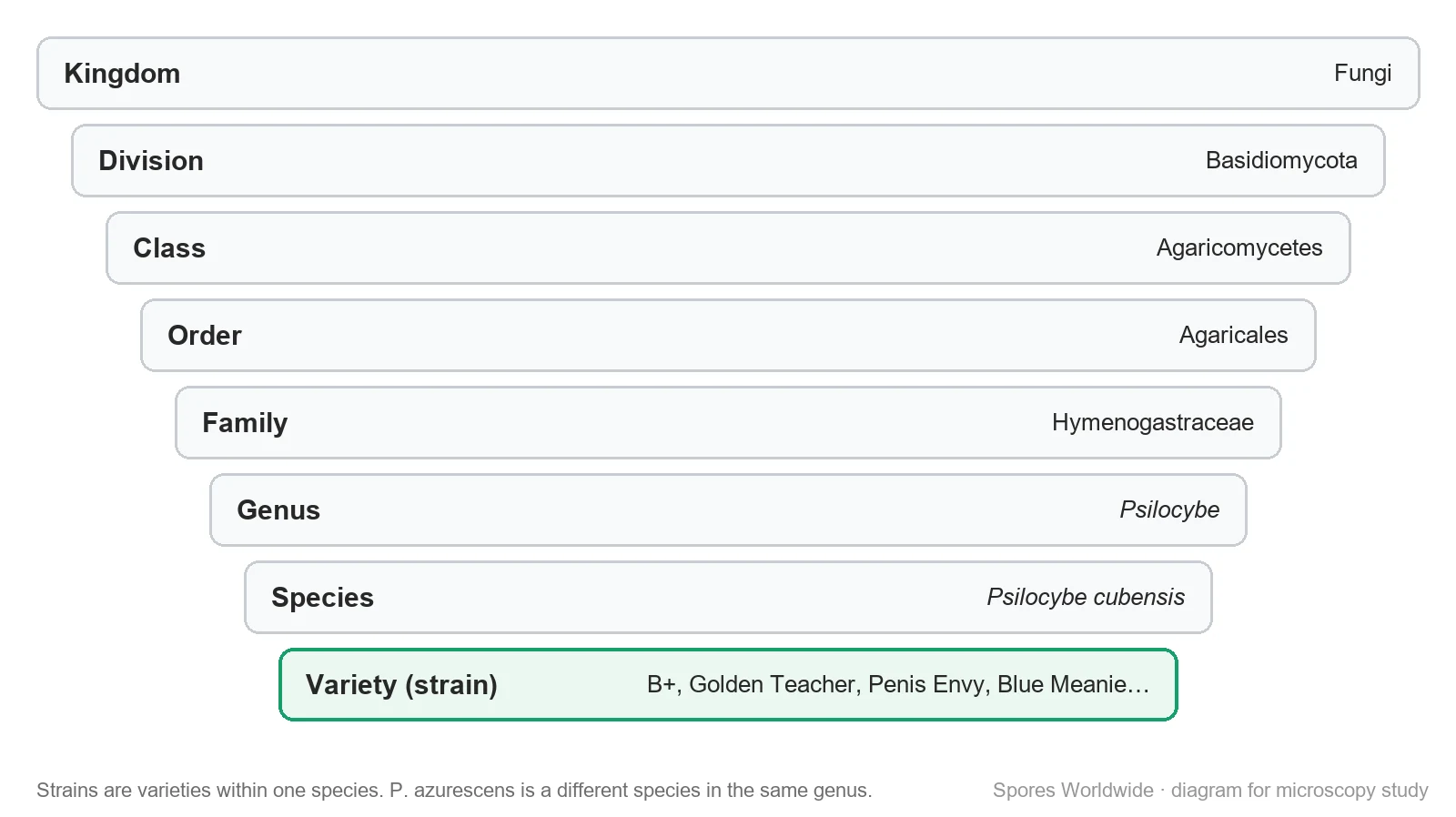
The classification of fungi shows why the claim is so unlikely. A strain is a variety within a species. P. cubensis and P. azurescens are two different species in the same genus, and they’re very different organisms:
| Psilocybe cubensis | Psilocybe azurescens | |
|---|---|---|
| Described | 1906, by Franklin Sumner Earle, from Cuba (as Stropharia cubensis) | 1995, by Paul Stamets and Jochen Gartz |
| Where it grows | Cow dung, rich pasture soil | Wood chips and sandy soil with woody debris, often near coastal dune grasses |
| Spore print | Purple | Dark purplish brown to purplish black |
Sources: Wikipedia, Psilocybe cubensis and Psilocybe azurescens.
Crossing two separate species is a very different thing from crossing two varieties of one species, and we’re not aware of any documented, stable cubensis × azurescens hybrid. B+ prints and spores are typical of P. cubensis.
What the microscope can and can’t tell you
B+ spores should fall within the normal P. cubensis range: sub-ellipsoid, 11.5–17.3 × 8–11.5 µm, with a purple-brown print. That makes B+ a good strain for checking your measuring technique against published figures.
A microscope can’t settle the hybrid question on its own, though. Spore size and shape tell you a sample is consistent with a species; proving or disproving that a strain is a cross needs DNA sequencing. What you can do is record careful measurements and compare B+ with other varieties of the same species, like Golden Teacher and Penis Envy.
Preparing a B+ slide
- Clean a glass slide and cover slip.
- Roll the B+ spore syringe between your palms to resuspend the spores, then place one small drop on the slide. From a print, scrape a tiny amount into a drop of sterile water instead.
- Lower the cover slip at an angle to avoid air bubbles.
- Find spores at 100×, check their shape at 400×, and measure at 1000× oil immersion with a calibrated eyepiece reticle. Measure 20 or more spores and record length, width and shape.
The full method, with photos and a troubleshooting table, is in How to use a spore syringe for microscopy. To keep syringes and prints in good condition between sessions, see How to store spore syringes, prints and swabs.
B+ spores from Spores Worldwide
Each product is prepared by hand in our Ottawa lab under HEPA-filtered laminar flow. We ship to the USA, Canada and worldwide (except Egypt and Turkey).
- B+ Spore Syringe: 10cc of B+ spores in sterile water.
- B+ Spore Print: a spore deposit on foil, good for print-colour study and long-term storage.
Browse every strain in Spore Syringes and Spore Prints.
Related reading
- Golden Teacher spores: strain profile
- Penis Envy spores: the PE family
- How to make a spore print
- Are mushroom spores legal?
Frequently asked questions
What is B+?
B+ (B plus) is a variety, or strain, of Psilocybe cubensis. It has circulated since the late 1990s and is one of the oldest strain names still in use.
Is B+ a hybrid of cubensis and azurescens?
That’s the legend, but it was disputed from the start and we’re not aware of any published genetic evidence for it. P. cubensis and P. azurescens are separate species, and B+ behaves like a cubensis variety, including its purple-brown spore print.
Why is it called B+?
Nobody has recorded why. The name has been used since the strain first circulated in the late 1990s.
What do B+ spores look like under a microscope?
Like other P. cubensis spores: sub-ellipsoid and purple-brown, within the published range of 11.5–17.3 × 8–11.5 µm. Use 400x to see their shape and 1000x oil immersion to measure them.
Are B+ spores legal?
It depends on where you live. Some jurisdictions restrict spores directly, and others restrict anything intended for producing mushrooms. Our guide, Are mushroom spores legal? (https://sporesworldwide.com/are-mushroom-spores-legal/), links to the laws for the US and Canada. Check your own local law before ordering.